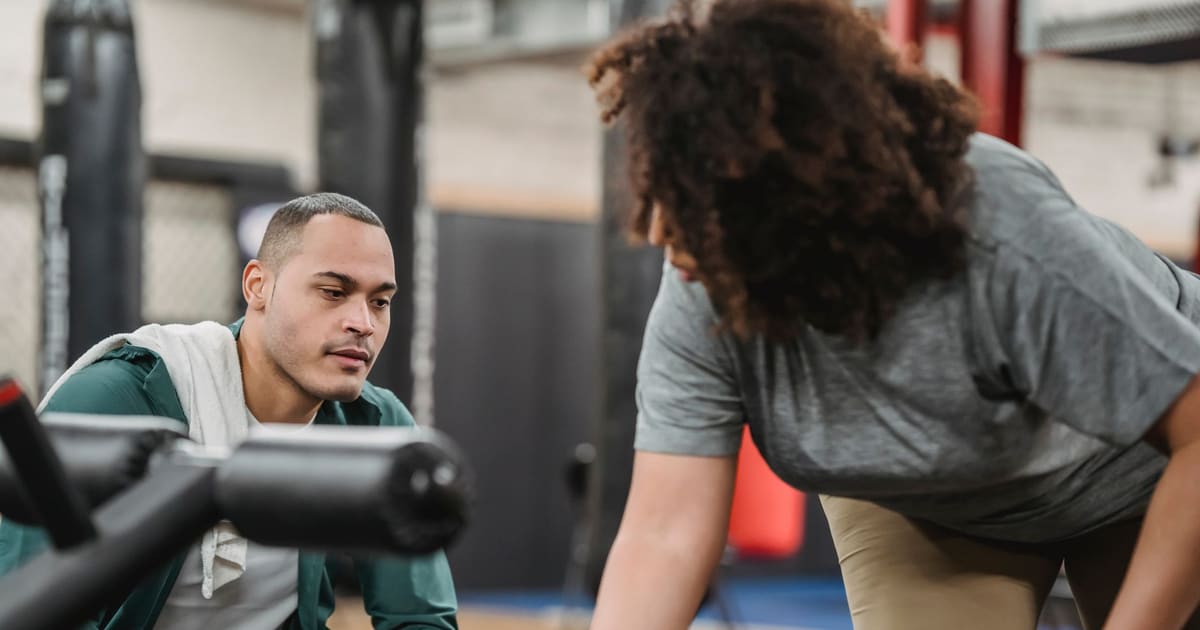
A personal trainer designs and supervises exercise sessions with a primary focus on movement quality, progressive overload, and physical performance outcomes. A fitness coach takes a broader approach that includes behavioral habits, mindset, lifestyle consistency, and often motivation and accountability alongside exercise. In practice, the titles overlap and are sometimes used interchangeably -- which is part of what makes choosing between them confusing for consumers.
What a personal trainer does: scope and credentials
A personal trainer's core job is exercise programming and in-session supervision. In a typical session, a personal trainer:
- Prescribes specific exercises, sets, reps, and load based on the client's goal
- Observes and corrects movement technique in real time
- Tracks performance data across sessions to apply progressive overload
- Adjusts programming in response to fatigue, injury, or progress plateaus
Personal training is the more tightly defined of the two roles in terms of industry credentialing. The standard for professional credibility is an NCCA-accredited certification. The four most widely recognized NCCA-accredited personal training credentials are:
- National Academy of Sports Medicine (NASM) -- CPT
- American Council on Exercise (ACE) -- CPT
- National Strength and Conditioning Association (NSCA) -- CPT or CSCS
- American College of Sports Medicine (ACSM) -- CPT
These certification bodies require candidates to pass proctored exams with published content standards, and most require continuing education for renewal. For a full breakdown of what these credentials involve and how to verify them, see What Certifications Should a Personal Trainer Have?.
A personal trainer does not treat injuries, provide medical nutrition therapy, or function as a therapist. If a trainer's scope of practice questions are answered clearly, these boundaries will be explicit.
What a fitness coach does: scope and credentials
A fitness coach's scope is less standardized. In broad usage, a fitness coach works with clients on:
- Habit formation and consistency around exercise
- Goal setting and accountability between sessions
- Lifestyle factors that affect training outcomes (sleep, stress, recovery)
- Motivation and mindset alongside or instead of direct exercise instruction
Some fitness coaches also provide exercise programming and session supervision similar to a personal trainer. Others operate entirely as behavioral change guides without prescribing or supervising exercise directly. The service varies significantly between practitioners.
The credentialing landscape for fitness coaching is fragmented. There is no single widely recognized credentialing body equivalent to NCCA for personal training. Organizations that offer fitness or health coaching credentials include the National Board for Health and Wellness Coaching (NBHWC) and several fitness industry training organizations, but the rigor and market recognition of these credentials vary.
Because the title is unregulated, a consumer evaluating a self-described fitness coach should ask directly:
- What credentials do you hold, and who issued them?
- What does your coaching actually include -- do you program and supervise exercise, or is your focus on habits and accountability?
- What is your experience with clients who have my specific goal?
Key differences in certification standards and accountability
The most practical difference between the two titles for a consumer is the presence or absence of a standardized credentialing process:
| Dimension | Personal trainer | Fitness coach |
|---|---|---|
| Regulated title in US? | No, but NCCA accreditation is industry standard | No -- title is unregulated |
| Primary credentialing body | NCCA (certifies NASM, ACE, NSCA, ACSM) | NBHWC for health coaching; no universal PT-equivalent |
| Core job scope | Exercise programming and supervision | Habits, accountability, lifestyle -- may include exercise |
| Typical session format | In-person or remote supervised exercise | Phone, video, or app-based coaching check-ins |
| Typical cost | $50 - $100/session (in-person) | $100 - $400/month (retainer model) |
When a personal trainer is the right choice
A personal trainer fits your needs when:
- Your primary goal involves learning specific physical movements (strength training, athletic performance, post-injury return to exercise)
- You need real-time form correction that behavioral coaching cannot provide
- Your goal is physical performance improvement -- strength, power, endurance -- rather than primarily habit and lifestyle change
- You have an injury history that requires movement screening and individualized programming
If your goal involves complex or high-risk movements, a personal trainer's hands-on supervision provides value that a coaching-only relationship cannot replicate.
When a fitness coach is the right choice
A fitness coach fits your needs when:
- Your primary barrier to fitness is consistency, motivation, and habit -- not lack of knowledge about what to do
- You already know how to exercise safely and need accountability rather than instruction
- You prefer a broader accountability relationship that includes lifestyle factors like sleep, stress, and schedule management
- You are working toward behavior change goals where exercise is one component among several
Some people benefit from both simultaneously -- a personal trainer for technical skill development and a fitness coach or online coach for the accountability layer between sessions. For a comparison of personal training and online coaching formats, see Personal Trainer vs. Online Coach: What Is the Difference?.
Cost comparison between the two roles
Personal trainers typically charge per session. The standard range is $50 to $100 per in-person session in most US markets, with premium markets and highly experienced trainers charging above that range, based on IDEA Health and Fitness Association survey data. At two sessions per week, monthly cost runs $400 to $800 at mid-range rates.
Fitness coaches more commonly use a monthly retainer model. Rates typically range from $100 to $400 per month for ongoing coaching that includes goal-setting sessions, accountability check-ins, and communication between sessions. Some fitness coaches who also provide exercise programming charge more, approaching personal trainer rates for higher-touch service.
For the best comparison of online coaching cost specifically, see Online Fitness Coaching Cost: What You Pay and What You Get.
Key takeaway
The choice between a personal trainer and a fitness coach comes down to what you actually need. If you need someone to teach you how to move, correct your form, and build a program around your physical capacity, a credentialed personal trainer is the right hire. If you know how to exercise and need accountability, habit structure, and lifestyle guidance, a fitness coach addresses that need more directly. When evaluating either title, ask about credentials and scope before making any financial commitment.
What to look for in either title when evaluating credentials
Regardless of which title a practitioner uses, the questions worth asking before hiring are the same:
- What certification or credential do you hold, and who issued it?
- Is your certification NCCA-accredited (for personal trainers) or from a recognized credentialing body?
- What does your service actually include -- in-person exercise supervision, remote check-ins, programming, accountability, or some combination?
- What experience do you have with clients who have my specific goal?
For a step-by-step guide to the full trainer evaluation process, see How to Choose a Personal Trainer.
Frequently asked questions
Is a fitness coach the same as a personal trainer?
No. A personal trainer is primarily focused on designing and supervising exercise sessions -- movement selection, form, progressive overload, and physical performance. A fitness coach takes a broader scope that typically includes habits, lifestyle, mindset, and consistency patterns alongside or instead of direct exercise instruction. The titles overlap in practice, but the core job description differs.
Does a fitness coach need to be certified?
There is no legal requirement for a fitness coach to hold any specific credential in the US. The title is unregulated. Some fitness coaches hold NCCA-accredited personal trainer certifications; others hold health coaching credentials from organizations like the National Board for Health and Wellness Coaching (NBHWC). Consumers should ask specifically what credential a fitness coach holds and whether it is nationally recognized.
Which is more expensive, a personal trainer or a fitness coach?
Personal trainers typically charge $50 to $100 per session for in-person sessions, according to IDEA Health and Fitness Association data. Fitness coaches more commonly charge monthly retainer fees of $100 to $400 for ongoing support, which may or may not include hands-on exercise supervision. The total cost comparison depends on session frequency and whether the coach provides in-person supervision or remote guidance only.
Can one person hold both a personal trainer and fitness coach credential?
Yes, and many practitioners do. A trainer who holds an NCCA-accredited CPT certification and an NBHWC-certified health or wellness coaching credential can legitimately work in both roles. When evaluating someone who claims both titles, ask specifically which services fall under which role, and how their pricing reflects that distinction.
What is a health coach and how is that different from a fitness coach?
A health coach works across multiple wellness domains including nutrition, sleep, stress management, and general lifestyle habits. A fitness coach typically focuses more narrowly on exercise habits and physical performance, though the titles are not standardized. Neither health coaching nor fitness coaching is regulated by a single governing body in the US, so the scope of each depends heavily on the individual practitioner's training and credentials.
Who regulates personal trainer and fitness coach credentials in the US?
No federal agency directly regulates personal trainer or fitness coach titles. The National Commission for Certifying Agencies (NCCA) provides third-party accreditation for certification organizations, and NCCA-accredited credentials are widely considered the industry standard for personal training. There is no equivalent universal accreditation body for fitness coaching. The National Board for Health and Wellness Coaching (NBHWC) is a recognized credentialing body in the adjacent health coaching space.