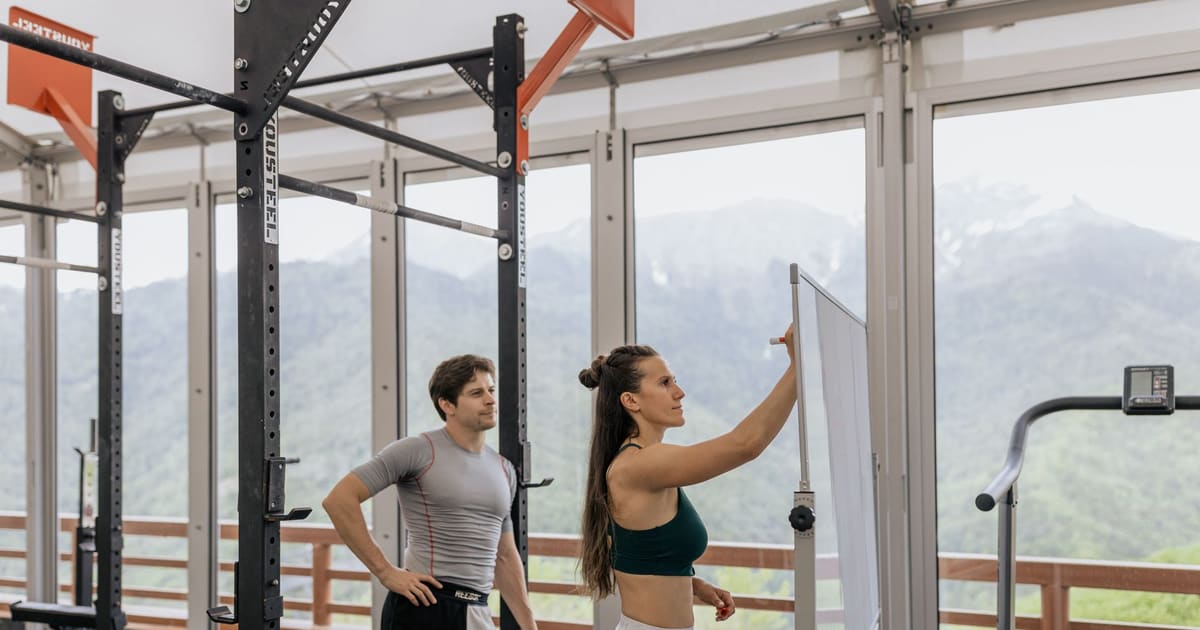
Beginners can start strength training independently with a structured program, but a trainer meaningfully reduces the risk of form errors on compound lifts and accelerates the learning curve during the first 8 to 12 weeks. Whether a trainer is necessary depends on how quickly you want to progress, your comfort learning movement patterns from video instruction, and whether any musculoskeletal history warrants supervised guidance.
What is strength training and why beginners often avoid it
Strength training is any training that uses external resistance -- barbells, dumbbells, machines, cable systems, or bodyweight -- to create progressive mechanical stress on muscles, bones, and connective tissue. The result, when combined with adequate recovery and nutrition, is increased muscular strength, improved body composition, better bone density, and enhanced metabolic rate.
Despite these documented benefits, beginners often delay starting for a few common reasons:
- Unfamiliarity with equipment and gym layout
- Fear of injury, particularly with barbell exercises
- Uncertainty about what program to follow
- Uncertainty about whether form is correct
These are addressable concerns, not permanent barriers. The relevant question is which path resolves them faster: independent study or working with a trainer.
The case for starting without a trainer: when DIY works
Starting strength training independently is a reasonable option for adults who:
- Have no significant injury history or musculoskeletal conditions
- Are willing to invest time learning form from reputable instructional sources (professional coaching videos from organizations like NSCA or credentialed coaches)
- Choose a well-structured beginner program that emphasizes fundamental movement patterns at low to moderate loads before progressive loading
- Train with a workout partner who can observe their form
Well-designed beginner programs exist in published form. Characteristics of programs that work for self-guided beginners include full-body training three days per week, emphasis on the major compound patterns (squat, hinge, push, pull, carry), and systematic load progression based on performance rather than arbitrary weekly jumps.
The risk of the self-guided path is that form errors on compound lifts can persist for months without external feedback. A squat with excessive forward lean, a deadlift with a rounded lower back, or an overhead press with flared elbows can feel normal to the person performing them. These errors may not cause immediate injury but create cumulative load on joints and connective tissue that becomes a problem as weight increases.
The case for hiring a trainer to start: form, safety, and programming
A qualified personal trainer provides three things that video instruction cannot: real-time movement observation, immediate correction, and programming adjusted to individual movement quality rather than a generic template.
For compound barbell lifts specifically -- squat, deadlift, bench press, overhead press, and barbell row -- the learning curve is steeper than it appears from watching video demonstrations. The proprioceptive experience of these movements (what they feel like in your body) is different from what they look like externally. A trainer can identify form errors the trainee cannot see or feel.
The NSCA's position on resistance training for beginners emphasizes that supervision and instruction significantly reduce injury risk during the early learning phase. This is particularly relevant for adults returning to exercise after a long sedentary period, those with previous joint or back issues, or beginners who want to progress to moderately heavy loads within the first few months.
You do not necessarily need a trainer for every session indefinitely. Many beginners use a trainer for an initial block of 8 to 12 sessions to establish movement competency, then transition to independent training with periodic check-ins. This approach captures most of the safety benefit at a fraction of the long-term cost.
For an honest assessment of when trainer investment pays off across different goals and experience levels, see Is a Personal Trainer Worth It?.
What a beginner strength program typically includes
A well-structured beginner program covers these components, regardless of whether it is trainer-designed or self-guided:
Movement pattern coverage. The major patterns are: squat (quad-dominant, lower body), hinge (hip-dominant, posterior chain -- includes the deadlift), push (horizontal and vertical -- bench press, overhead press), pull (horizontal and vertical -- rows, pull-ups or lat pulldown), and carry (loaded walking or farmer carry). A program that omits any of these patterns creates imbalances over time.
Session frequency. ACSM recommends that beginners train each muscle group two to three times per week. Full-body three-days-per-week programs meet this standard efficiently.
Progressive load structure. Beginners typically add weight each session in the early phase, as neural adaptation allows relatively rapid strength gains. This phase is called "novice linear progression." A program should specify when and how to increase weight rather than leaving that decision to feel alone.
Rest periods. For strength development, rest periods of 90 seconds to three minutes between sets are appropriate. Rest periods under 60 seconds favor metabolic conditioning over strength gain and are not optimal for beginners focused on learning compound lifts.
Warm-up protocol. A specific warm-up that includes movement-pattern preparation (not just static stretching) helps reduce injury risk and improves session performance. A trainer will include this by default; a self-guided beginner needs to build it into their routine intentionally.
How long before a beginner can train independently?
Most beginners who work with a qualified trainer develop sufficient movement competency to train independently on primary compound lifts within 8 to 16 sessions, assuming they attend consistently and practice the movements between sessions.
"Independence" in this context means: performing the primary lifts with safe form at moderate loads, understanding how to warm up for each movement, knowing how to progress load over time, and recognizing when a form breakdown signals too much weight.
Periodic trainer check-ins every 4 to 6 weeks after the initial block can catch form drift and provide programming adjustments as load increases. This hybrid model costs far less than ongoing weekly training while preserving the safety and programming benefits.
For guidance on how many sessions per week to book when you do start with a trainer, see Personal Trainer for Muscle Gain: Do You Need One? which covers session frequency in the context of hypertrophy goals.
Gym vs. home training for beginners: equipment and cost
Both settings are viable for beginner strength training, with different equipment constraints:
| Setting | Minimum equipment | Monthly cost | Limitations |
|---|---|---|---|
| Commercial gym | Full barbell setup, dumbbells, machines | $10 - $50/month membership | Travel time; crowded peak hours |
| Home gym (basic) | Adjustable dumbbells, bench | $400 - $800 one-time | Limited barbell work; no spotting |
| Home gym (full) | Squat rack, barbell, plates | $800 - $2,000 one-time | Space requirements; upfront cost |
A commercial gym membership gives beginners access to the full range of equipment needed for compound barbell training at a low monthly cost. Home gyms have higher upfront costs but may be more consistent for people who struggle with gym attendance habits.
If budget is a constraint, use the Training Budget Calculator to compare options based on your realistic training frequency and preferred format.
Warning
Before starting a strength training program, consult your physician or a licensed healthcare provider if you have a cardiovascular condition, musculoskeletal injury, have been sedentary for an extended period, or are returning to exercise after a significant absence. Strength training is appropriate for most adults, but individual health conditions may warrant modified programming.
When self-guided programs fall short
Even well-intentioned beginners with good instructional resources commonly run into these issues without trainer oversight:
- Skipping the learning phase and loading too quickly because they feel ready
- Performing the deadlift with a rounded lower back and not recognizing it as a problem
- Avoiding movements that feel awkward rather than working through the learning curve
- Following an advanced program that is inappropriate for their current movement quality
- Not progressing load at all because they are uncertain when it is safe to increase weight
None of these are character flaws -- they are predictable knowledge gaps. A trainer's role in the beginner phase is largely to close these gaps efficiently. For guidance on what to look for in a trainer and how to verify credentials before paying for sessions, see How to Choose a Personal Trainer.
Key takeaway
Beginners can start strength training without a trainer using a structured program and credible instructional resources. A trainer meaningfully reduces form error risk on compound lifts and accelerates early learning. A practical middle path: invest in 8 to 12 initial sessions to establish movement competency, then train independently with periodic check-ins as load increases.
Frequently asked questions
Can a complete beginner do strength training without a trainer?
Yes. Beginners can learn strength training independently using a reputable structured program and video instruction for form reference. The risk is that without real-time feedback, form errors on compound lifts -- squat, deadlift, overhead press -- can persist and increase injury risk over time. A few initial sessions with a qualified trainer to establish form reduces that risk significantly.
What is progressive overload and do beginners need to understand it?
Progressive overload is the practice of gradually increasing the demand on your muscles over time by adding weight, reps, or sets. It is the primary mechanism by which strength and muscle gains occur. Beginners do not need to master the concept before starting, but understanding the principle helps them avoid two common errors: staying at the same weight indefinitely or jumping weight too aggressively.
How many days per week should a beginner do strength training?
ACSM guidelines recommend that beginners train each major muscle group two to three times per week with at least 48 hours of recovery between sessions targeting the same muscles. For most beginners, a full-body routine three days per week (such as Monday, Wednesday, Friday) meets this standard and leaves adequate recovery time while building the habit.
Is it normal to be sore after the first strength training session?
Yes. Delayed onset muscle soreness (DOMS) typically peaks 24 to 72 hours after a novel training stimulus, particularly when the muscles were previously untrained. DOMS is a normal physiological response to new stress and is not a sign of injury. It diminishes significantly after the first 2 to 4 weeks as the body adapts to the training stimulus.
What is the difference between strength training and weightlifting?
Strength training is a broad category covering any training that uses external resistance -- barbells, dumbbells, machines, or bodyweight -- to build strength and muscle. Weightlifting, in formal usage, refers specifically to the Olympic sport of the snatch and the clean and jerk. Most beginners mean general resistance training when they say weightlifting; the terms are often used interchangeably in consumer contexts.
How long does it take a beginner to see strength gains?
Beginners typically see measurable strength gains within 4 to 6 weeks of consistent training, according to published exercise science literature. Early gains reflect neurological adaptation -- the nervous system becoming more efficient at recruiting muscle fibers -- rather than muscle growth, which takes longer. Consistent training, adequate protein intake, and sufficient sleep all contribute to the rate of adaptation. Individual results vary widely.